Tankless vs. Tank Water Heaters for South Florida Homes
By the Boca Raton 24/7 Plumbing team · September 17, 2026
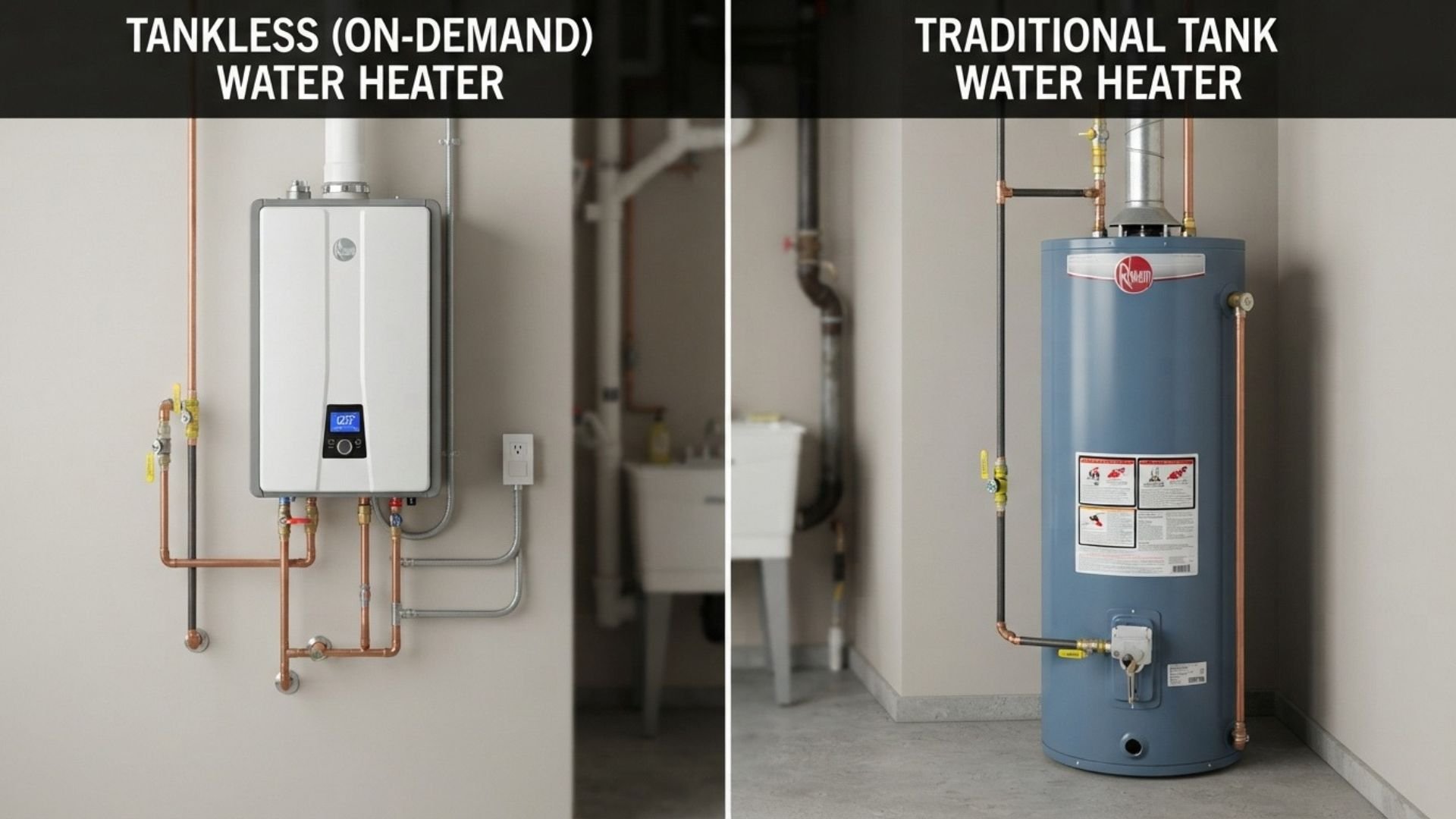
Your water heater died, or it's old enough that you're thinking ahead, and now you're facing the tank-versus-tankless decision. It's a genuinely different choice than it might have been a decade ago, tankless technology has matured, but it's still not a universal upgrade that makes sense for every household. Here's an honest look at how the two actually compare for a South Florida home.
How they work, briefly
A tank water heater stores a set volume of hot water, 40, 50, 80 gallons depending on the model, keeping it heated and ready at all times. When you run out, you wait for it to reheat. A tankless unit heats water on demand as it flows through, with no storage tank at all. That means it doesn't "run out" in the traditional sense, but it does have a maximum flow rate it can heat at once, which matters when multiple fixtures run simultaneously.
Upfront cost and installation
Tank units cost less upfront, both for the unit itself and typically for installation, especially when replacing an existing tank in the same location. Tankless units cost more for the equipment and often require additional installation work, larger gas lines for gas models, or dedicated electrical circuits for electric models, and sometimes new venting. If you're switching from tank to tankless rather than replacing a tankless unit with another one, factor in this conversion cost, which can be a meaningful part of the total project and one that's easy to underestimate when only comparing unit prices side by side.
Long-term operating costs
Tankless units are generally more energy-efficient since they're not continuously heating and reheating stored water the way a tank does, especially relevant for a household that isn't drawing hot water constantly throughout the day. Over a tankless unit's longer working life, typically 15-20 years versus a tank's 8-12, the efficiency savings can offset a meaningful portion of the higher upfront cost. The exact payback period still depends heavily on your household's actual hot water usage patterns and local utility rates.
Space and lifestyle considerations
Tankless saves space
Wall-mounted and compact, tankless units free up floor space that a bulky tank occupies, genuinely useful in a smaller condo or townhome utility closet.
Tank handles simultaneous use better
A large enough tank can supply multiple fixtures at once without the flow-rate limits a tankless unit has to manage.
Tankless never "runs out"
For households that value long showers or back-to-back use over time rather than simultaneous use, tankless avoids the classic "ran out of hot water" problem entirely.
The maintenance difference that matters most here
This is the detail South Florida homeowners specifically need to know: tankless units require more regular maintenance than tanks, particularly annual descaling to clear mineral buildup from the compact heat exchanger. Boca Raton's water, drawn from the Biscayne Aquifer's limestone formation, is moderately hard, and that mineral content accumulates inside a tankless unit's heat exchanger faster than in a tank's larger, simpler design. Skipping annual descaling is one of the most common reasons a tankless unit underperforms or fails earlier than its rated lifespan.
A whole-home water softener can meaningfully reduce this maintenance burden if you're already dealing with hard water concerns for other reasons, since less mineral content reaching the unit means less scale buildup to clear.
What happens if you skip maintenance on either type
Neglect affects tank and tankless units differently, which is worth understanding regardless of which you choose. A tank left unflushed accumulates sediment at the bottom, which insulates the heating element and reduces efficiency, and eventually contributes to the corrosion that leads to a tank leak. A tankless unit left undescaled sees its heat exchanger gradually restricted by mineral scale, leading to reduced flow, inconsistent temperature, and eventually error codes or component failure. Both problems are preventable with routine maintenance, but tankless maintenance is more time-sensitive since scale buildup happens faster in a compact heat exchanger than sediment accumulates in a large tank.
A note on heat pump water heaters
Worth mentioning as a third option: heat pump water heaters. They pull heat from the surrounding air rather than generating it directly, and can significantly reduce electricity use compared to a standard electric tank. Florida's warm climate is actually a good match for how this technology works most efficiently. They cost more upfront than a standard tank and need adequate air space around the unit to function properly, which can be a real constraint in a tight utility closet, but for the right property, they're worth including in the comparison alongside tank and tankless.
So which one is actually right for you?
If you have a larger household with genuinely simultaneous hot water demands, multiple bathrooms in use at once, a dishwasher and shower running together regularly, a properly sized tank sometimes handles that more straightforwardly than a tankless unit's flow-rate limits allow. If you're in a smaller condo or townhome where space matters, or you're tired of running out of hot water and are willing to commit to annual maintenance, tankless is a genuinely good fit. There's no universal right answer, it depends on your specific household's actual usage patterns, not on which option is more talked about at the moment.
Ready to compare options for your home?
Our water heater installation and replacement page covers sizing for both tank and tankless options, and tankless water heater service covers what ongoing maintenance actually involves if you go that route. This decision comes up constantly in Highland Beach's condo communities, where space considerations often tip the choice toward tankless.
Whichever direction you're leaning, we can walk through your household's actual usage, how many bathrooms, whether hot water demand tends to overlap or stagger throughout the day. That helps you land on the option that genuinely fits rather than the one that's simply trendiest at the moment.