Hydro Jetting vs. Snaking: Which Clears a Drain for Good?
By the Boca Raton 24/7 Plumbing team · September 17, 2026
Your drain is clogged again. Maybe it's the second or third time this year, maybe the plumber who came out last time snaked it and it cleared right up, only to slow down again a few weeks later. At some point, the question shifts from "how do I clear this clog" to "why does this keep happening," and that's exactly where the choice between snaking and hydro jetting actually matters.
What each method actually does
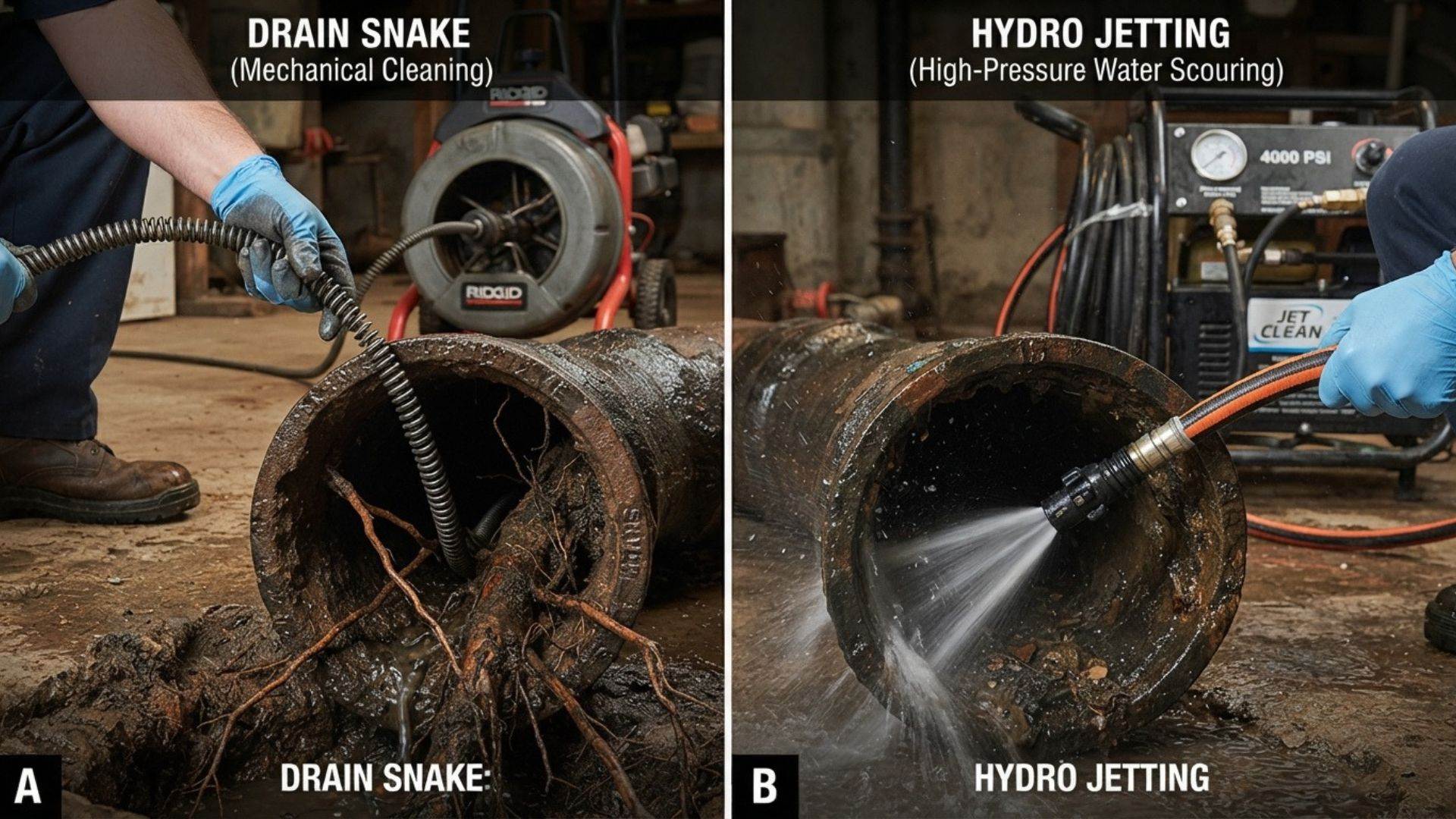
A drain snake, sometimes called a cable or auger, is a flexible metal cable with a cutting or grabbing head on the end. It gets fed into the pipe and either grinds through a blockage or hooks onto debris and pulls it back out. It's fast, it's the standard first response to most clogs, and it genuinely solves the majority of drain problems the first time.
Hydro jetting works differently. Instead of a mechanical cable, it uses a hose that sprays water at very high pressure in multiple directions as it travels through the pipe. Rather than punching a path through a blockage, it scours the entire interior surface of the pipe clean, removing grease, scale, and debris from the full diameter, not just carving a channel through the middle of it.
Why a snaked drain sometimes clogs again quickly
This is the detail that explains most repeat-clog frustration. A snake is genuinely effective at clearing an obstruction, but if the underlying cause is grease buildup coating the pipe walls or root intrusion at a pipe joint, the snake typically pushes through the blockage rather than removing the material causing it. The pipe looks clear again because water is flowing, but the grease lining the walls or the root mass at the joint is still mostly there, just with a channel punched through the middle. It's not a matter of the snake failing, it's a matter of the tool doing exactly what it's designed to do, which isn't the same thing as fully resolving a buildup problem.
When each one is the right call
| Situation | Better fit |
|---|---|
| First-time clog, single fixture, no history of repeat issues | Snaking |
| Clog returns within weeks after snaking | Hydro jetting |
| Grease-heavy kitchen line | Hydro jetting |
| Suspected root intrusion in a sewer lateral | Hydro jetting, often paired with camera inspection first |
| Older, potentially fragile pipe of unknown condition | Camera inspection before either method |
That last row matters more than people expect. Hydro jetting is generally safe for cast iron, clay, and PVC, but a severely deteriorated line, one that's already cracking or has thin spots, can be damaged by the pressure. A quick camera check first isn't always necessary, but for a line with unknown age and condition, it's a reasonable precaution.
What actually gets removed during jetting
It helps to picture what's actually happening inside the pipe during a jetting job. The nozzle at the end of the hose has multiple angled jets, some pointing forward to cut through blockages ahead, others pointing backward and to the sides to scour the pipe wall as the hose is pulled back through. Grease, mineral scale, root hairs, and general buildup that's accumulated over years get stripped off the interior surface and flushed downstream, rather than compacted or pushed aside the way a mechanical auger tends to do. The result is a pipe that's genuinely clean on the inside, not just clear enough for water to pass.
Does jetting work on every type of clog?
Not quite every situation calls for it. A solid, hard obstruction, like a foreign object lodged in the line, is sometimes better addressed by a mechanical tool that can grab and remove it directly, since high-pressure water alone might not dislodge something solid and rigid. Similarly, a pipe with a genuine structural problem, a collapsed section or severe misalignment, needs a structural repair, not cleaning of any kind, since the pipe itself has failed rather than just accumulated buildup. This is exactly why a camera inspection sometimes comes before jetting on a line with an uncertain history: it tells you whether you're dealing with a cleaning problem or a repair problem before committing to either.
The cost difference, and why it's usually worth it
Hydro jetting typically costs more than a basic snaking job, since it requires specialized equipment and takes somewhat longer to complete properly. For a genuine one-time clog, that extra cost usually isn't necessary, snaking solves the problem completely and there's no reason to pay more. But for a recurring clog, the math flips. Paying for a snaking visit every few weeks or months, only to have the same problem return, adds up to more than a single hydro jetting visit that actually resolves the underlying buildup.
What this looks like for Boca Raton specifically
Older homes on the east side of Boca Raton, particularly those still running original clay or cast iron sewer laterals, see this pattern often. Tree root intrusion at aging pipe joints is a genuine local factor, roots seek out any moisture source, and a cracked joint in an old sewer line is exactly that. A line that's been snaked repeatedly without a lasting fix is a strong candidate for hydro jetting combined with a camera inspection to confirm whether root intrusion is the actual driver.
Not sure which you need?
If you're dealing with a drain that keeps coming back, our hydro jetting page covers what the process actually involves, and sewer camera inspection can confirm the cause before you commit to either approach. For a straightforward single clog, standard drain cleaning is usually all that's needed. This exact question comes up often from Delray Beach's Osceola Park and Old Floresta homes, where original plumbing is common.
Either way, describing the clog's actual history on the call, how many times it's happened, whether it was ever snaked before, and how quickly it came back, gives us a much better starting point than treating every call as a first-time clog.